03 · Outsourced Financial Reporting

Hand over the reporting, keep the control

Hedge accounting, derivative valuations and scenario analysis, produced every period inside your governance. Your policy, your sign-off, our production work and audit evidence.

EVERY REPORTINGPERIOD01Tradecapture02Marketdata03Valuations &XVA04Effectivenesstesting05Journals &disclosures06Auditpack

What we run

Three services, one close

Many treasuries don't need a full-time hedge accountant. The work is technical, the volumes are lumpy, and the audit risk sits in a few weeks of the year.

IFRS 9 · IAS 39 · ASC 815

Hedge accounting

Designation, documentation, effectiveness testing, journals and disclosures, for cash flow, fair value and net investment hedges.

  • Hedge documentation library maintained
  • Effectiveness testing and rebalancing
  • Journals and IFRS 7 / ASC 815-10-50 disclosures
IFRS 13 · ASC 820

Derivative valuations

Independent fair values on every reporting date, reconciled to counterparty marks, with credit adjustments included.

  • Interest rate, FX, commodity and credit derivatives
  • CVA, DVA and FVA
  • Fair value hierarchy levelling and support

Stress · Sensitivity

Scenario analysis

What happens to the hedges, the P&L and the balance sheet if rates, FX or commodity prices move, ready for the board and the notes.

  • Sensitivity analysis for market risk disclosures
  • Stress and reverse stress scenarios
  • Board and ALCO reporting on hedge outcomes

Every reporting period

What lands on your desk

  • Monthly hedge accounting close: designation, testing and journal entries
  • Independent derivative and XVA valuations on every reporting date
  • Designation packs and the hedge documentation library kept current
  • Rebalancing analysis and rebalancing journals
  • Disclosure tables ready for the auditors
  • Quarterly board or ALCO reporting on effectiveness and P&L impact
  • Audit support: first-line responses, walkthroughs and evidence
  • Model governance and independent validation where required
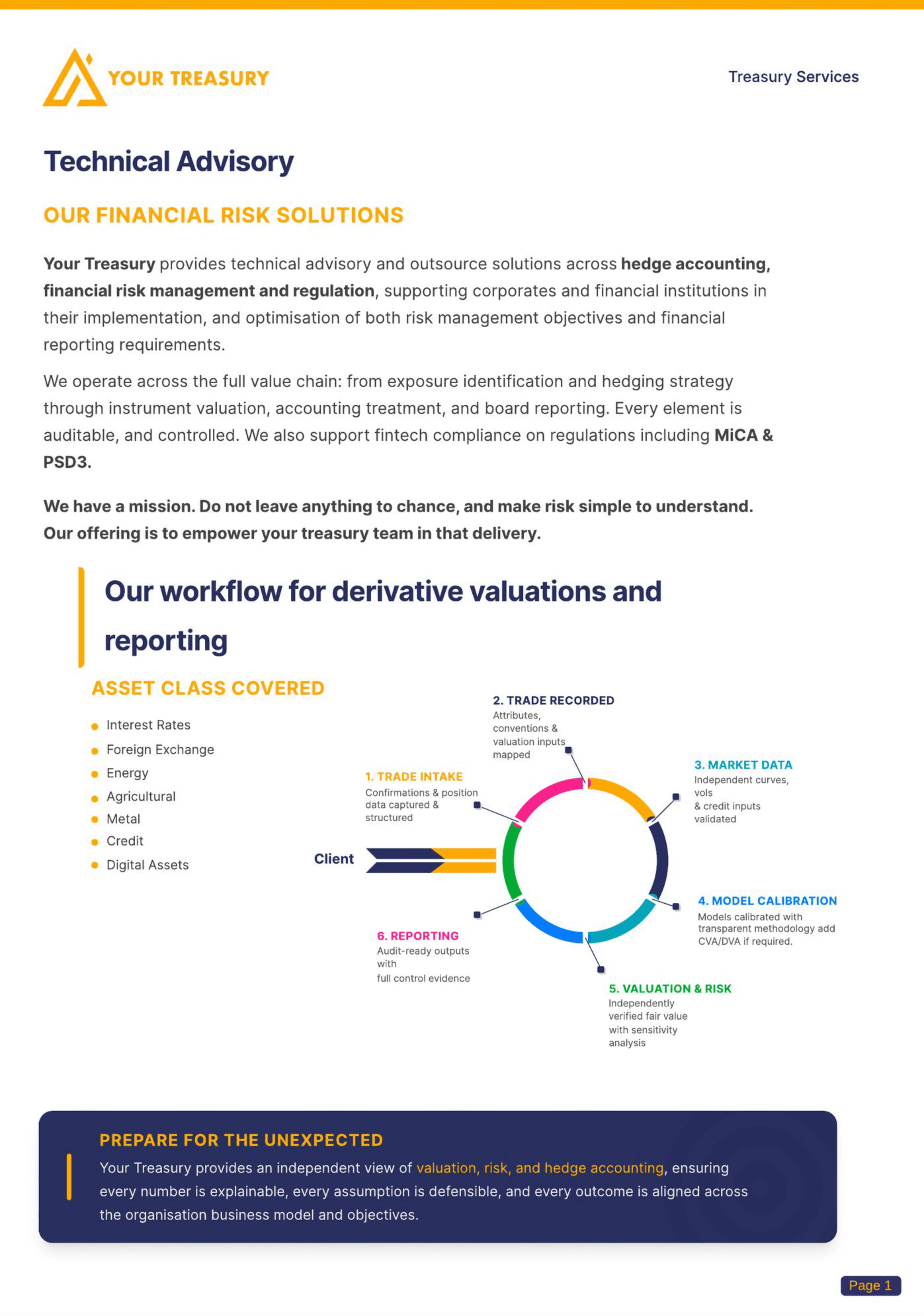
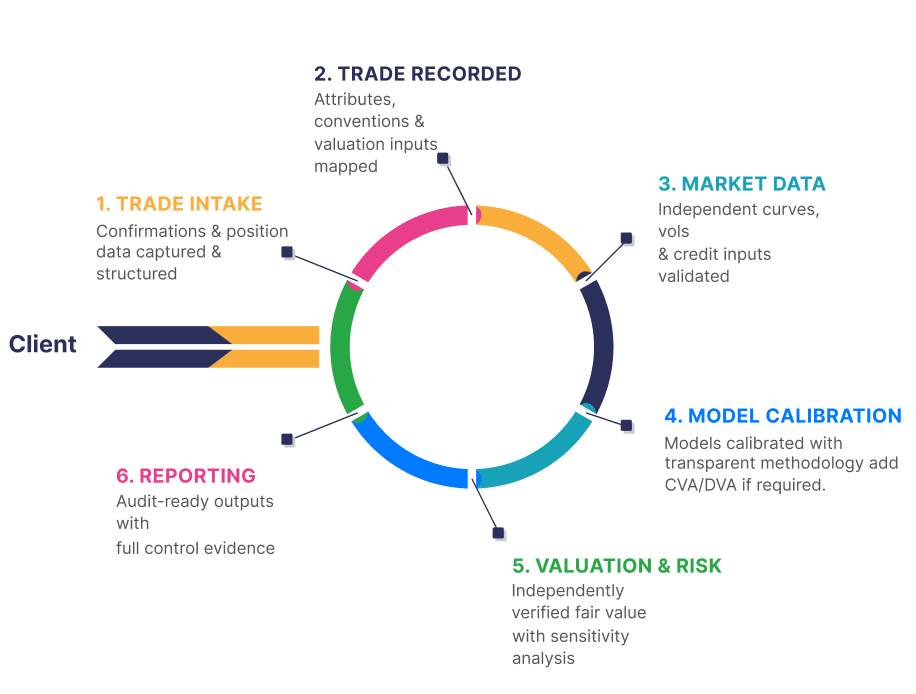
Our workflow for derivative valuations and reporting: Trade intake, Trade recorded, Market data, Model calibration, Valuation & risk, Reporting.

Specialisms

Where the standard close isn't enough

Component & macro hedging

Risk components of non-financial items under IFRS 9, and macro hedging of banking portfolios under the IAS 39 carve-out.

Transition to RMA

A roadmap from IAS 39 / IFRS 9 hedge accounting to Risk Management Accounting, aligning reporting with how risk is managed.

XVA

Counterparty valuation adjustments with expected exposure modelling and collateral effects, integrated with your valuation engine.

IFRS 9 vs ASC 815

Reporting under both? These are the differences that bite

Groups that report under one framework and consolidate under the other run two sets of rules on the same trades. We work the boundary in both directions. Here is where it matters most.

EffectivenessEffectiveness threshold
Material difference

IFRS 9

No bright line. Requires an economic relationship, credit risk not dominating the value changes, and a hedge ratio consistent with how risk is actually managed.

US GAAP · ASC 815

The hedge must be 'highly effective', which practice reads as offset within 80 to 125%.

So whatA hedge can qualify under IFRS 9 and fail ASC 815 on the same numbers. Dual reporters need both tests on file.

QualificationRisk components of non-financial items
Material difference

IFRS 9

Allowed if the component is separately identifiable and reliably measurable, whether or not it is contractually specified.

US GAAP · ASC 815

Allowed for forecast purchases or sales only where the component is contractually specified.

So whatCommodity hedgers can often hedge a market benchmark component under IFRS 9 that US GAAP would not allow, creating more ineffectiveness under ASC 815.

MeasurementCash flow hedge ineffectiveness
Material difference

IFRS 9

Lower-of test: the cash flow hedge reserve holds the lesser of the cumulative change in the instrument and the hedged item. Over-hedging ineffectiveness goes to profit or loss.

US GAAP · ASC 815

No separate measurement of ineffectiveness. The whole change in the instrument's fair value included in the assessment goes to OCI and is reclassified when the hedged item affects earnings.

So whatThe same hedge can show P&L noise under IFRS 9 and none under US GAAP.

DiscontinuationVoluntary de-designation
Material difference

IFRS 9

Not permitted while the risk management objective for the relationship is unchanged and the criteria are still met.

US GAAP · ASC 815

Permitted at any time.

So whatIFRS 9 relationships are stickier. Design them carefully, because you may not be able to walk away.

EffectivenessRetrospective assessment
Different

IFRS 9

Assessment is prospective only. Ineffectiveness is still measured and recognised each period.

US GAAP · ASC 815

Prospective and retrospective assessments, at inception and at least every quarter.

So whatUS GAAP needs a backward-looking test in the quarterly close; IFRS 9 needs the ineffectiveness calculation instead.

EffectivenessQualitative assessment
Different

IFRS 9

Qualitative assessment is acceptable where critical terms match closely; otherwise a quantitative method is needed.

US GAAP · ASC 815

After a quantitative test at inception, later assessments may be qualitative if the entity can reasonably support continued high effectiveness. Shortcut and critical-terms-match methods also exist.

So whatBoth allow lighter-touch ongoing testing, but the evidence trail and eligibility conditions differ.

QualificationDesignation and documentation timing
Different

IFRS 9

Formal designation and documentation at inception of the hedging relationship.

US GAAP · ASC 815

Designation documented at inception, but the initial quantitative effectiveness test may be completed up to the first quarterly assessment date. Private companies get further relief.

So whatMissing inception documentation is fatal under both. US GAAP gives a short window for the number-crunching only.

QualificationGroups and net positions
Different

IFRS 9

Groups of items, including net positions, can be hedged items subject to conditions, with specific presentation rules.

US GAAP · ASC 815

Net positions are not eligible hedged items. A gross amount within the group must be designated instead.

So whatTreasuries that hedge net FX exposure need a gross designation workaround under US GAAP.

MeasurementExcluded components (time value, forward points, basis)
Different

IFRS 9

Option time value, and optionally forward points and currency basis, can be treated as a cost of hedging: deferred in OCI and released to profit or loss over the hedge period or with the hedged transaction.

US GAAP · ASC 815

Excluded components are recognised in earnings, either through a systematic and rational amortisation (with the remaining change in OCI) or at fair value each period.

So whatBoth can smooth the cost of options and forward points, but the mechanics and disclosures differ.

DiscontinuationRebalancing
Different

IFRS 9

Required when the hedge ratio drifts but the risk management objective is unchanged. Rebalancing continues the relationship.

US GAAP · ASC 815

No rebalancing concept. Changes in the hedge mean de-designating and re-designating, in whole or in part.

So whatIFRS 9 lets you adjust without a restart. Under US GAAP every change is a new relationship with fresh documentation.

PresentationIncome statement presentation
Different

IFRS 9

No general requirement to present hedge results in the hedged item's line. Net position hedges use a separate line.

US GAAP · ASC 815

The earnings effect of the hedging instrument must be presented in the same income statement line as the hedged item.

So whatLine-item mapping in the GL and consolidation tool often differs between the two reporting packs.

EffectivenessShortcut method
Different

IFRS 9

No shortcut method.

US GAAP · ASC 815

Qualifying interest rate swaps can assume perfect effectiveness under the shortcut method, if the strict conditions are met throughout.

So whatShortcut is efficient but unforgiving: a failed condition can unwind the accounting back to inception.

PortfoliosPortfolio and macro interest rate hedging
Different

IFRS 9

IFRS 9 lets entities keep IAS 39 for portfolio fair value hedges of interest rate risk, including the EU carve-out. The IASB's dynamic risk management model is still in development.

US GAAP · ASC 815

The portfolio layer method allows fair value hedges of a layer of closed portfolios of prepayable financial assets.

So whatBanks run different macro models under each framework, and the IFRS side is set to change.

QualificationNet investment hedges
Broadly aligned

IFRS 9

Permitted. The effective portion goes to the foreign currency translation reserve in OCI.

US GAAP · ASC 815

Permitted, assessed using a spot or forward method. Amounts go to the cumulative translation adjustment, with excluded components eligible for amortisation.

So whatBroadly aligned in outcome, with method choices worth matching across the two packs.

A simplified summary for orientation, not a substitute for the standards or advice on your facts. Covers IFRS 9 (with IAS 39 where IFRS 9 allows it to continue) and ASC 815 as amended by ASU 2017-12 and the portfolio layer method.

Start a conversation

Ready to put your treasury to work?

Book a 30-minute diagnostic call. We'll tell you within the hour whether we can help, and where the biggest wins likely sit.

Or email us directly at [email protected]